




An important medium for tapping investment in the state is through collaboration between public and private partners. A typical PPP structure can be quite complex involving contractual arrangements between a number of parties including the government, project sponsor, project operator, financiers, suppliers, contractors, engineers, third parties (such as an escrow agent), and customers. Though, the actual structure of a PPP depends on the type of partnerships, the figure below shows a simplified PPP structure:
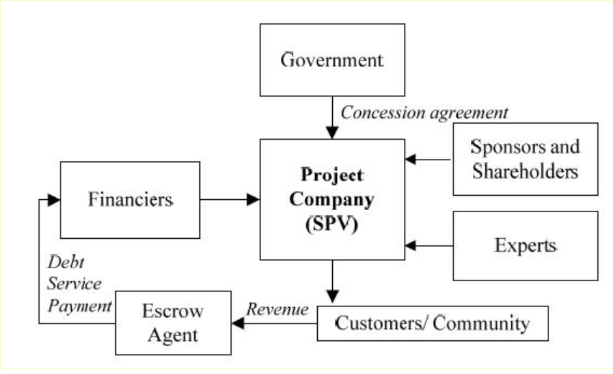
The box on the right side labelled "expert" represents various participating groups in a PPP project including engineers (designer), contractor (builder), operator and insurer.
Similarly, the box on the left side labelled "financiers" includes various parties investing in a project comprising equity and debt financiers which may include domestic and foreign banks and financial institutions, bi-lateral and multi-lateral donor agencies, development banks, and similar other agencies.
The box labelled "escrow agent" normally represents a financial institution that is appointed by the project company and the lenders for managing an account called escrow account. The escrow account is set up to hold funds (including project revenues) accrued to the project company. The funds in the account are disbursed by the escrow agent to various parties in accordance with the conditions of the agreements. An escrow account is also used to hold a deposit in trust until certain specified conditions are met.
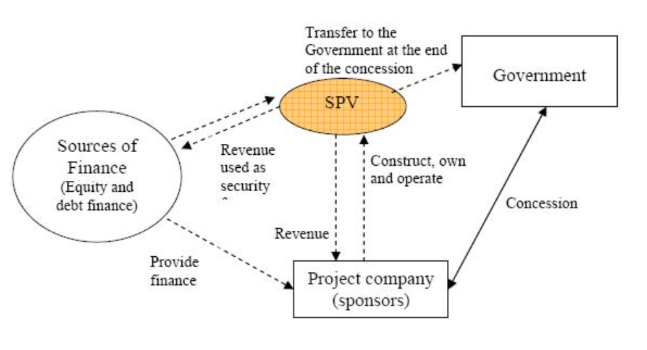
One of the broad categories of PPP model is the Concessions Model. In this form of PPP, the Government defines and grants specific rights to an entity (usually a private company) to build and operate a facility for a fixed period of time. The Government may retain the ultimate ownership of the facility and/or right to supply the services. In concessions, payments can take place both ways: concessionaire pays to government for the concession rights and the government may also pay the concessionaire, which it provides under the agreement to meet certain specific conditions. Usually such payments by the government may be necessary to make projects commercially viable and/or reduce the level of commercial risk taken by the private sector, particularly in the initial years of a PPP programme in a country when the private sector may not have enough confidence in undertaking such a commercial venture. Typical concession periods range between 5 to 50 years. The figure below shows the typical structure of a concession contract.
Some of the fixed period contractual arrangements for deploying resources under models such as Toll Operate Transfer (TOT), Build Own Operate and Maintain (BOOM), Operate Maintain Develop (OMD), Rehabilitate Operate Maintain Transfer (ROMT), Supply Operate and Transfer (SOT) and Design Build Finance Operate Transfer (DBFOT).
The Government of India has published a few Model Concession Agreements for PPP in various sectors through its different ministries and agencies. A few can be accessed at:

Meghalaya Government in 2021 came up with this policy with an aim to create a fine balance between the need of protecting the socio-cultural fabric of the state by honoring its commitments towards the special status provided to the state under the Constitution and the need for ensuring availability of resources for sustainable economic development by promoting projects through PPP mode.
The opportunities uploaded by state government departments seeking support from private partners can be looked at IIG portal, maintained by Invest India, Department for Promotion of Industry and Internal Trade (DPIIT), Ministry of Commerce of Industry.
We value your input and are eager to hear from you. Whether you have questions, suggestions, or just want to share your thoughts, this is the place to connect with us